Home Study

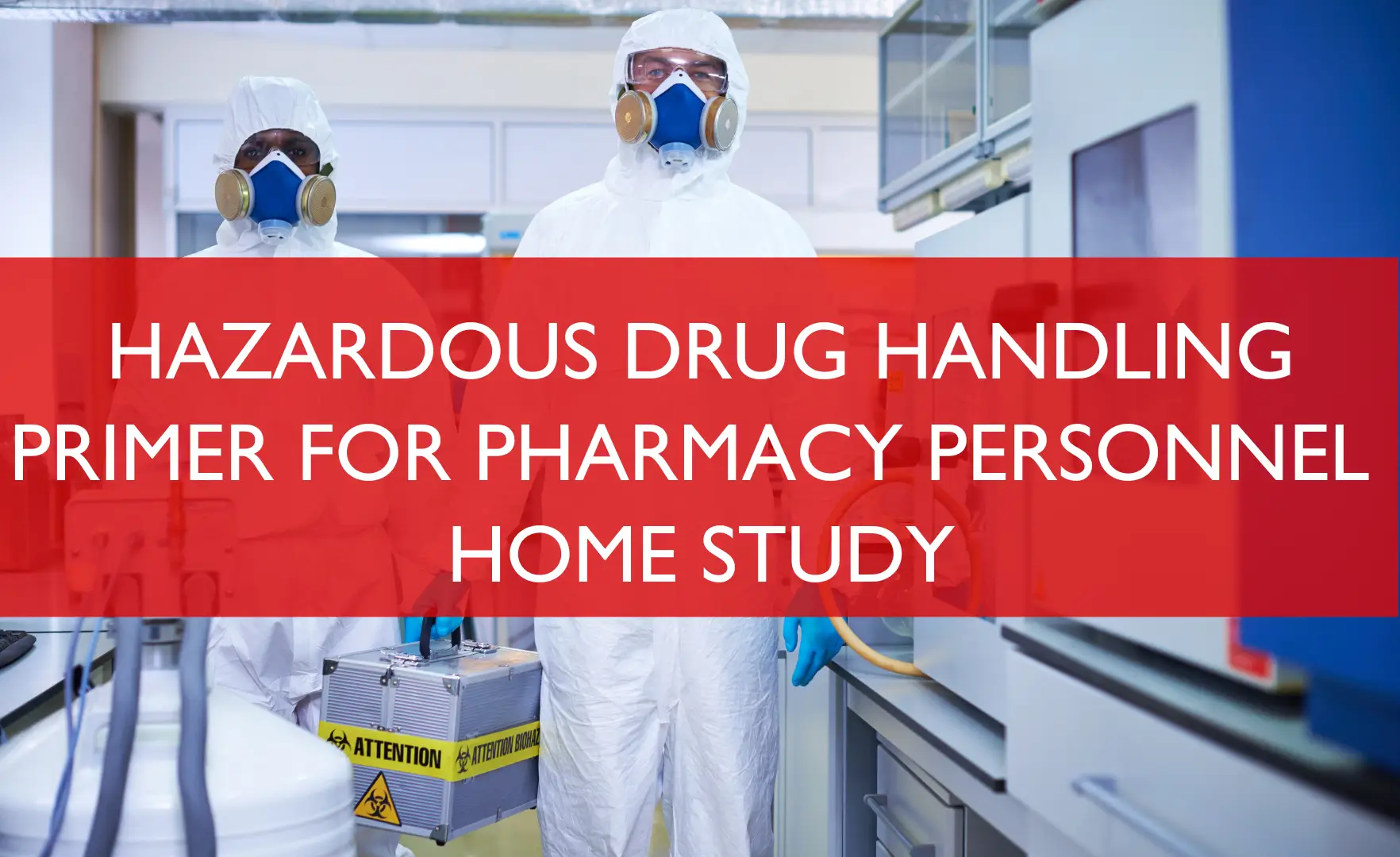
Hazardous Drug Handling Continuing Education for Pharmacy Personnel | 6-Hour PTCB-Recognized CE

2026-03-19T14:15:55-05:00February 20th, 2026|Categories: Continuing Education, Compliance, Hazardous drug handling, Home Study, Patient Safety, Pharmaceutical Training, Pharmacy Practice, Regulatory Issues, USP 800|Tags: , , , , , , , , , , , , , , , , |

Hazardous Drug Handling – Primer for Pharmacy Personnel is a 6-hour (0.6 CEUs) knowledge-based home study designed for pharmacists and pharmacy technicians who handle hazardous drugs in any practice setting.

This program reviews key requirements under USP <800>, including engineering controls, negative pressure rooms, PPE, cleaning and decontamination procedures, hazardous drug dispensing, receiving and transport, disposal requirements, medical surveillance, and wipe sampling. Participants will also review the NIOSH list and understand how to assess risk and develop compliant SOPs within their facility.

The course emphasizes practical steps to reduce occupational exposure and strengthen documentation and training practices.

This home study is PTCB-Recognized as an Education/Training Program and may help pharmacy technicians prepare for the CPhT-Adv Advanced Certification in Hazardous Drug Management.

Strengthen hazardous drug handling practices and reinforce USP <800> compliance through structured training designed to protect both patients and pharmacy personnel.

What participants said:

  • “informative, concise, and easy to comprehend.”
  • “I can take and apply this knowledge in my current pharmacy.”
  • “It was very organized and easy to follow.”

Registration is below

Note: It is not necessary to create a Lecture Panda account to register for this home study.

The American College of Apothecaries (ACA) is accredited by the Accreditation Council for Pharmacy Education as a provider of continuing pharmacy education. ACA has accredited this knowledge-based program for 6 contact hours (0.6 CEUs) of continuing education credit for pharmacists and pharmacy technicians.
Canadian Non-Sterile Compounding Standards: Continuing Education for Pharmacy Professionals

2026-04-02T09:23:13-05:00February 10th, 2026|Categories: Compliance, compounding, compounding training, Continuing Education, Documentation, Home Study, Pharmaceutical Training, Pharmacy Practice, Policies & Procedures, Quality Assurance, Regulatory Issues, Risk Management, SOPs|Tags: , , , , , , , |

This 6.0-hour (0.6 CEUs) knowledge-based home study is designed for pharmacists and pharmacy technicians involved in non-sterile compounding who want a clear understanding of Canadian regulatory standards and how they apply to day-to-day practice. The course focuses on reviewing current standards and best practices used to evaluate compounding procedures, develop pharmacy protocols, and apply appropriate quality controls to support the safety and effectiveness of non-sterile preparations for both patients and staff.


Documents Covered

  • Guidance on Pharmacy Compounding of Non-Sterile Preparations

  • Model Standards for Pharmacy Compounding of Non-Sterile Preparations

  • Printable and fillable forms to support documentation and recordkeeping


Topics Covered

  • Canadian regulatory guidelines and non-sterile compounding standards

  • Identifying risks and gaps in current compounding practices

  • Requirements for different levels of non-sterile compounding

  • Facility, equipment, and documentation expectations

  • Product and preparation requirements

  • Additional considerations for Level C non-sterile compounding


Who This Home Study Is For

  • Pharmacists involved in non-sterile compounding

  • Pharmacy technicians supporting compounding activities

  • Pharmacy professionals looking for a clearer understanding of Canadian non-sterile compounding standards

Review Canadian non-sterile compounding standards and understand how regulatory expectations apply to everyday pharmacy practice. 

What participants said:

  • “This course provided a very thorough and succinct explanation of all relevant information needed to safely implement compounding into the pharmacy workflow.”
  • “The instructor very clearly explained these concepts in a well-organized manner for the audience to comprehend.”
  • “The session provided a clear overview of current guidelines, easy access to commonly used compounding resources, and practical checklists that support safe compounding practices.”

Registration is below

Note: It is not necessary to create a Lecture Panda account to register for this home study.

Important note for Canadian participants:
Participants who are not receiving ACPE credit, including Canadian learners whose provincial regulatory bodies may not accept ACPE-accredited activities, will receive a Certificate of Completion upon successful completion of the post-test and evaluation. Certificates may be downloaded for personal records. Canadian pharmacists and pharmacy technicians are encouraged to confirm with their provincial college whether ACPE-accredited activities or certificates of completion meet their continuing competency requirements.


The American College of Apothecaries (ACA) is accredited by the Accreditation Council for Pharmacy Education as a provider of continuing pharmacy education. ACA has accredited this knowledge-based program for 6 contact hours (0.6 CEUs) of continuing education credit for pharmacists and pharmacy technicians.
Nonsterile Compounding Home Study | 11-Hour PTCB-Recognized CE

2026-03-19T14:35:11-05:00August 20th, 2025|Categories: Continuing Education, compounding, Home Study, Pharmaceutical Training, Pharmacy Law, Pharmacy Practice, Regulatory Issues, USP 795|Tags: , , , , , , , , , , , , , , , , , |

This knowledge-based, enduring home study is designed for compounding pharmacists and pharmacy technicians seeking a comprehensive foundation in nonsterile compounding practices. The program provides a broad overview of nonsterile compounding, with a strong focus on regulatory compliance, standards, dosage forms, and pharmaceutical calculations essential to safe and effective compounding.

Participants will review the regulatory landscape governing nonsterile compounding, including applicable federal and state considerations and key United States Pharmacopeia (USP) standards, with emphasis on USP <795>. The program also addresses the roles and responsibilities of compounding personnel, facility and equipment requirements, documentation, quality assurance, and patient safety considerations.

The curriculum includes in-depth discussions of the most common nonsterile dosage forms prepared by compounders, such as solutions, suspensions, topical preparations, capsules, suppositories, transdermal preparations, and tablet triturates. Each section explores formulation principles, preparation techniques, and quality control measures relevant to practice.

A dedicated pharmaceutical calculations module provides detailed explanations and practical examples to help learners develop proficiency in calculations commonly used in compounding. This module serves as a guide to reinforce accuracy, consistency, and confidence in compounding calculations.

This 11-hour knowledge-based home study is a PTCB-Recognized Education/Training Program, ensuring a quality and standardized learning experience for pharmacy technicians. The program is offered in a self-paced format, allowing learners to complete the material on their own schedule.

Build a strong foundation in nonsterile compounding and strengthen your skills in compliance, dosage forms, and pharmaceutical calculations. Registration is below.

What participants said:

  • “Covered all of the material in an effective manner.”
  • “Several topics were covered in detail.”
  • “I could complete the program at my own pace, which allowed me to take the time needed to fully process and understand the material.”

Note: It is not necessary to create a Lecture Panda account to register for this home study.

The American College of Apothecaries (ACA) is accredited by the Accreditation Council for Pharmacy Education as a provider of continuing pharmacy education. ACA has accredited this knowledge-based program for 11 contact hours (1.1 CEUs) of continuing education credit for pharmacists and pharmacy technicians.
ACA HOME STUDY: Dermatological Compounding

2025-10-31T12:23:59-05:00April 16th, 2025|Categories: Continuing Education, compounding, Dermatology, Home Study, USP 800, Workplace Skills|Tags: , , , , , |

Our Dermatological Compounding Home Study is an accredited 5-hour knowledge-based program designed specifically for compounding pharmacists and pharmacy technicians. This self-paced learning program provides a thorough overview of the formulation and preparation of creams, emulsions, ointments, pastes, gels, PLOs, solutions, lotions, powders, and both semi-solid and commercially available bases.
Participants will also review important compendial standards, including microbial content, minimum fill, quality control, preparation and labeling, patient counseling, and guidelines for establishing and extending beyond-use dates.

Course Highlights Include:

Introduction to Compounding

  • History of pharmaceutical compounding
  • USP chapters and drug monographs
  • Best practices and evolving trends in the U.S.

Dermatological Disease States Covered:

  • Atopic Dermatitis (Eczema): Clinical features, treatment options, and custom formulations
  • Psoriasis & Cutaneous Infections: Includes dermatophytosis, candidiasis, and warts
  • Acne Vulgaris & Rosacea: Differentiation, treatment overviews, and compoundable therapies

Whether you’re looking to strengthen your foundational knowledge or expand your skill set in dermatological compounding, this home study offers a well-rounded, practical approach. Enroll now and learn at your own pace! Registration is below.


The American College of Apothecaries (ACA) is accredited by the Accreditation Council for Pharmacy Education as a provider of continuing pharmacy education. ACA has accredited this knowledge-based program for 5 contact hours (0.5 CEUs) of continuing education credit for pharmacists and pharmacy technicians.
Go to Top